
Food labels can feel intentionally confusing, especially when terms like organic, conventional, and non-GMO get thrown around as if they mean the same thing. They don’t. These labels represent three very different agricultural systems, each with its own rules, environmental impacts, and nutritional considerations.
Below is a clear guide to what actually separates these categories—so you can make informed choices about what you feed your family.
What “Organic” Means (According to Science & Regulation)
In the U.S., organic farming is regulated by the USDA National Organic Program (NOP). The rules are strict and cover everything from how soil is managed to how animals are raised. But, you still have to be cautious when searching products. Organic is thrown around a lot on products that are not actually certified organic. Shop with caution and watch for actual certifications and not just the word, “organic.”
Organic regulations prohibit:
Synthetic pesticides and herbicides
Synthetic fertilizers
GMOs of any kind
Sewage sludge (often used as fertilizer in conventional farming)
Ionizing radiation (used to sterilize some foods)
Routine antibiotic use in animals
Synthetic growth hormones
Organic farms must use:
Natural or biological pest control
Crop rotation
Compost, manure, and natural mineral amendments
Practices that enhance soil health and biodiversity
Pasture-based systems for livestock
Nutritional and chemical differences:
Research analyses (including large meta-analyses) have found that organic crops often contain:
Higher antioxidant levels
Lower cadmium concentrations (a heavy metal absorbed by plants and is classified as a carcinogen)
Lower or zero synthetic pesticide residues
Differences in fatty acid profiles in organic meat and dairy (often higher omega-3s)
Environmental impact:
Organic agriculture emphasizes:
Soil carbon sequestration
Reduced groundwater contamination
Higher biodiversity (birds, insects, soil microbes)
Less chemical runoff
Bottom line: “Organic” is a full-system designation covering chemicals, farming methods, soil health, and animal welfare—not just the absence of GMOs.
What “Conventional” Means
“Conventional” isn’t a certification—it’s simply the default industrial agriculture model.
Typical features of conventional farming:
Use of synthetic pesticides (glyphosate, atrazine, pyrethroids, etc. - all of which are linked to health issues such as cancer and endocrine disruption)
Use of synthetic nitrogen, phosphorus, and potassium fertilizers (these can cause negative health and environmental effects)
Genetically Modified seeds are common
Monocropping (planting the same crop on large acreage)
Routine antibiotics in some livestock operations
Growth-promoting hormones allowed in beef cattle
Chemical exposure:
Conventional produce may legally contain pesticide residues. However:
Some pesticides accumulate in fat tissues over time
Children are more vulnerable to chronic low-dose exposure
Real-world mixtures of multiple chemicals are difficult to study
Environmental impact:
Compared to organic, conventional systems generally show:
More soil erosion
More nitrogen and phosphorus runoff
Declining soil organic matter
Reduced pollinator and wildlife populations (Remember…we all die without the bees!)
Greater use of fossil fuels for fertilizer production
Yield differences:
Conventional farming usually produces 10–20% higher yields, depending on crop and region—which is partly why it’s cheaper. Does 10-20% more really justify all the harmful chemicals?
What “Non-GMO” Actually Means
This label (often seen as “Non-GMO Project Verified”) refers only to the absence of genetically engineered ingredients. It does not regulate how the crop was grown, what chemicals were used, or how livestock were treated.
Non-GMO rules typically prohibit:
Genetically engineered seeds
Genetically engineered feed for animals
Recombinant hormones like rbST
Non-GMO does not regulate:
Synthetic pesticides
Synthetic fertilizers
Soil health practices
Animal welfare
Packaging chemicals
Processing methods
A non-GMO crop can still be heavily sprayed with synthetic herbicides and insecticides.
Environmental & nutritional considerations:
Non-GMO farming usually falls between conventional and organic—but closer to conventional because the farming system itself doesn’t change.
Why the label exists:
Most GMO crops in the U.S. are designed to:
Tolerate herbicides (e.g., glyphosate-tolerant soy/corn)
Produce internal insecticides (Bt corn)
Avoiding GMOs indirectly helps reduce your exposure to:
Herbicide-resistant crop systems
Foods that may have higher glyphosate residues
But it does not guarantee organic-level purity or environmental benefits.
Comparison at a Glance
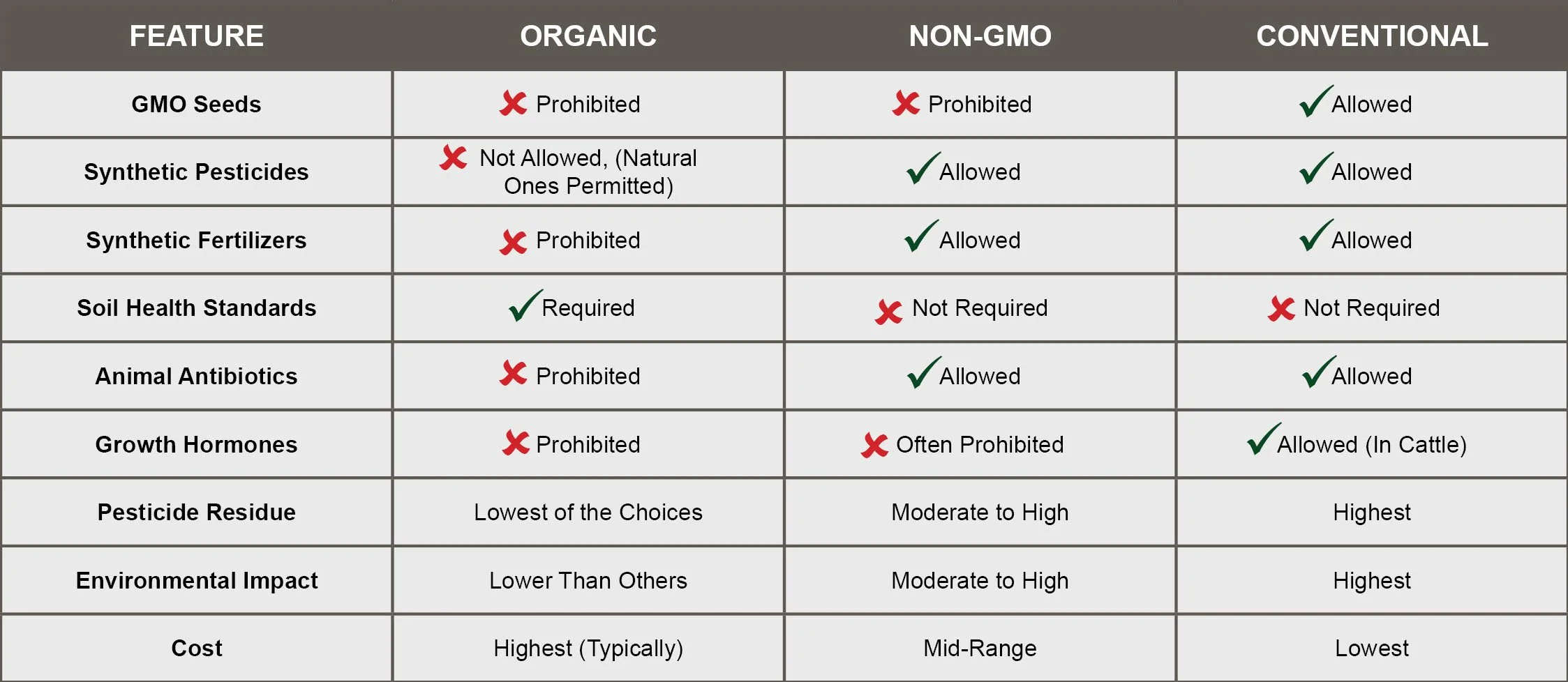
Which Should You Choose? An Informed Guide
If your priority is reducing chemical exposure: Choose organic whenever possible. Studies consistently show organic produce has significantly fewer synthetic residues.
If your priority is budget + fewer GMOs: Choose non-GMO, but know it’s not pesticide-free. Pair it with strategic organic buys using the Dirty Dozen list.
If your priority is environmental impact: Organic systems outperform conventional in soil health, biodiversity, and chemical runoff.
If your priority is nutrients: Organic sometimes contains higher antioxidants and better fatty acid profiles. But freshness, variety, and cooking methods often matter more than certification.
Final Thoughts
Understanding these labels lets you shop with intention instead of confusion. Organic is the most comprehensive and environmentally responsible system, conventional is the most accessible and affordable, and non-GMO sits in between but only addresses one slice of the agricultural puzzle. You don’t need to change everything at once—just knowing the differences allows you to choose what matters most for your family.
